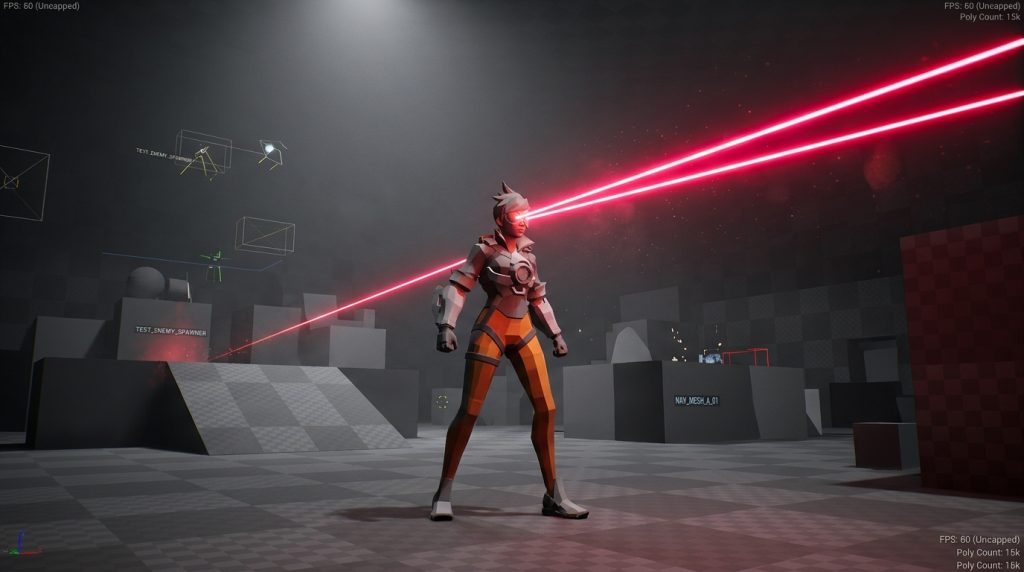

Game design rarely follows a pristine, linear path. Before character balances, competitive meta tiers, and cinematic lore trailers define a flagship title, studio internal builds resemble chaotic testing grounds. Blizzard Entertainment’s team-based hero shooter Overwatch underwent this identical trial by fire. Today, Lena Oxton—better known as Tracer—stands as the definitive face of the franchise: an agile, dual-pistol-wielding, chronal-skipping speedster. Yet, during the foundational weeks of late 2013, Tracer dominated internal multiplayer tests not through high-velocity ammunition, but by melting her teammates with straight beams of red laser energy fired straight out of her skull.
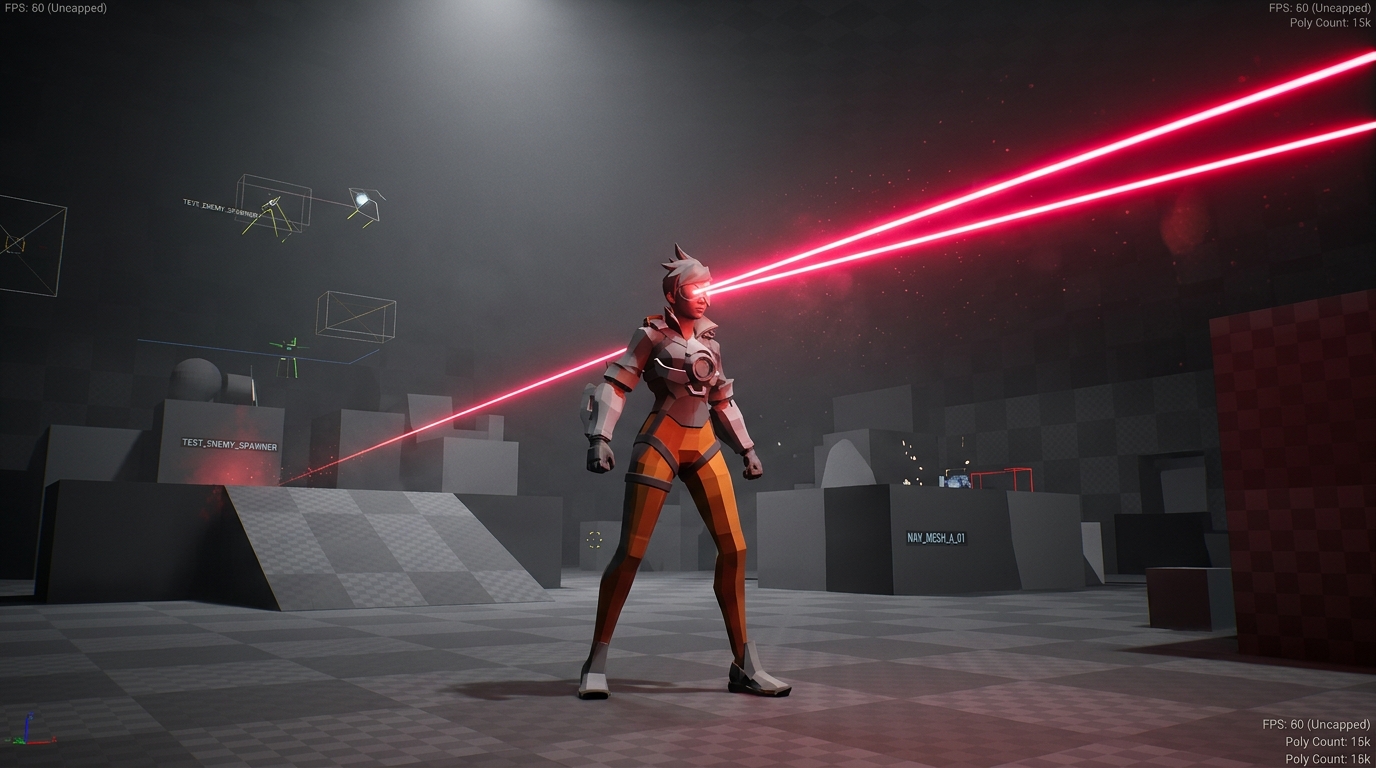
During behind-the-scenes retrospectives, Game Director Aaron Keller recalled that the initial hours of testing the core engine lacked modern graphical polish. Tracer, the very first operative built to establish scale, movement cadence, and spatial orientation, entered greybox environments without functional weapon models or projectile systems. To verify hit registration, the development crew bound simple line renders directly to the first-person camera view. The result was an accidental sci-fi terror: a hyper-mobile prototype sprinting across unfinished textures while blasting twin crimson laser beams from her eyes.
This quirk was never meant to survive into commercial production, but it highlights a vital window into technical game architecture. What began as a placeholder workaround evolved into a legendary piece of studio trivia—and unexpectedly opened the door to future combat design possibilities.
Behind the Greybox: The 2013 Engine Prototype Explained
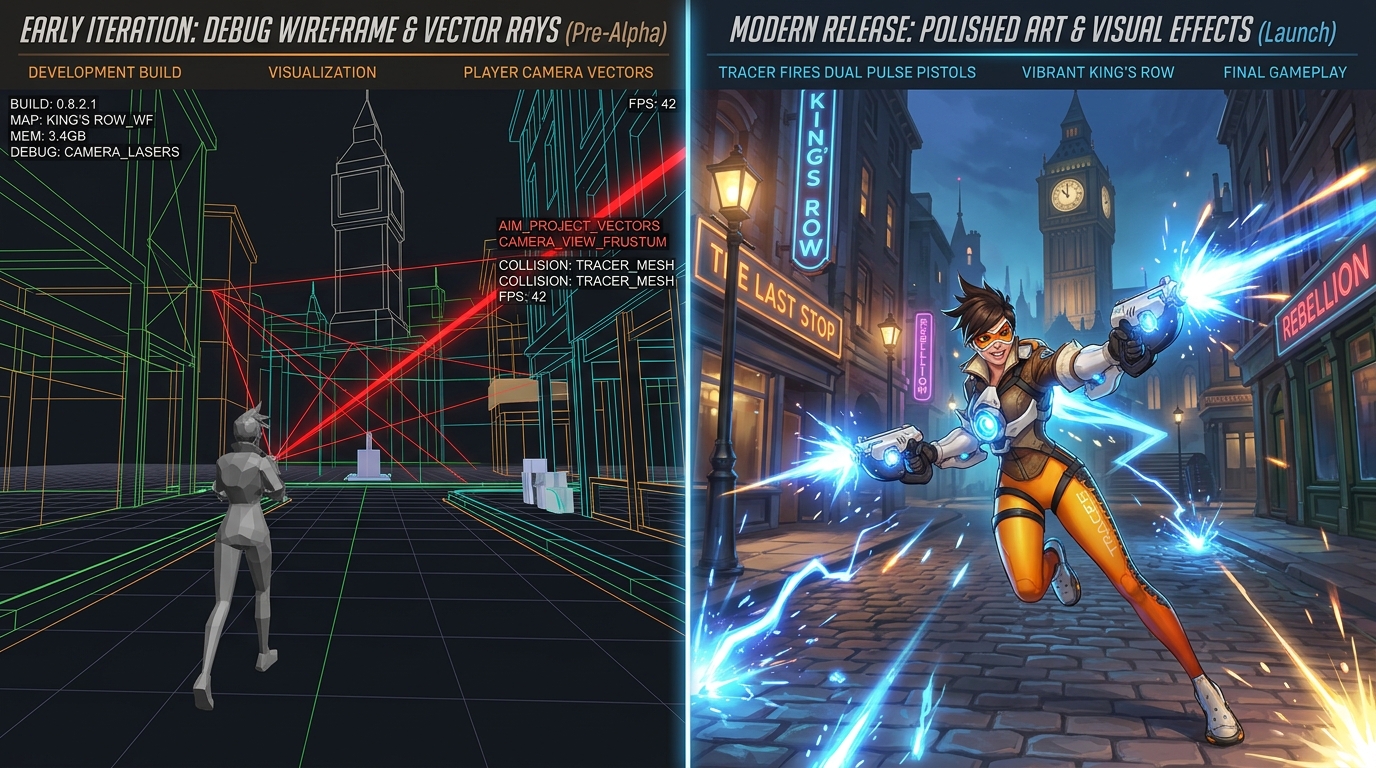
Every competitive shooter requires a baseline hero to calibrate camera height, movement speed, field-of-view thresholds, and server-side hit detection. In late 2013, as the remnants of Blizzard’s canceled project Titan crystallized into Overwatch, the engineering team constructed an entirely bespoke engine tailored specifically to support fast-paced, high-tick-rate hero combat.
At that developmental milestone, foundational systems were entirely missing:
-
Zero Projectile Frameworks: Bullet travel time, ballistic arcs, drop-off curves, and physical entity spawning did not exist in the code base.
-
Absent First-Person Weapon Rigs: Tracer’s trademark dual pulse pistols were neither modeled, rigged, nor animated for first-person perspective.
-
Camera-Coupled Hitscan: To test whether player viewports correctly aligned with collision boxes, developers tethered simple graphical line vectors directly to the primary camera node.
-
Geometric Raycasting: When pulling the trigger, the game engine cast two identical red geometric rays straight outward along the camera’s forward vector, aligning precisely with the player character’s ocular line.
As Aaron Keller recounted, the office playtests were instantly chaotic. Engineers and designers darted through bare arenas, dodging unbroken horizontal scarlet beams slicing through the air. The mechanic was crude, untextured, and visually bizarre, yet it proved that spatial queries, latency compensation, and player collision could hold up under rapid directional shifts.
From Ocular Heat Beams to Chronal Dual Pistols
Once the underlying networking code demonstrated stability, the creative team shifted focus toward thematic alignment. While eye-mounted lasers functioned effectively for mathematical hit tests, they clashed sharply with Lena Oxton’s British test-pilot lore and kinetic personality.
Tracer required a kit centered entirely on temporal mechanics: manipulating personal speed, slipping backward through time via Recall, and darting horizontally using Blink. A sustained ocular death ray grounded her momentum; rapid hitscan machine pistols complemented it.
Transitioning to dual pulse pistols solved several spatial issues. It freed up Tracer’s screen center, introduced dynamic reload rhythms, forced engagement at close-to-medium flanking distances, and established visual clarity for opponents tracking her movement trails. The twin red lines were quietly deprecated into version-control archives, making way for the iconic rapid-fire sound profiles that defined the game’s 2016 launch.
Will Blizzard Ever Ship a Hero With Eye Lasers?
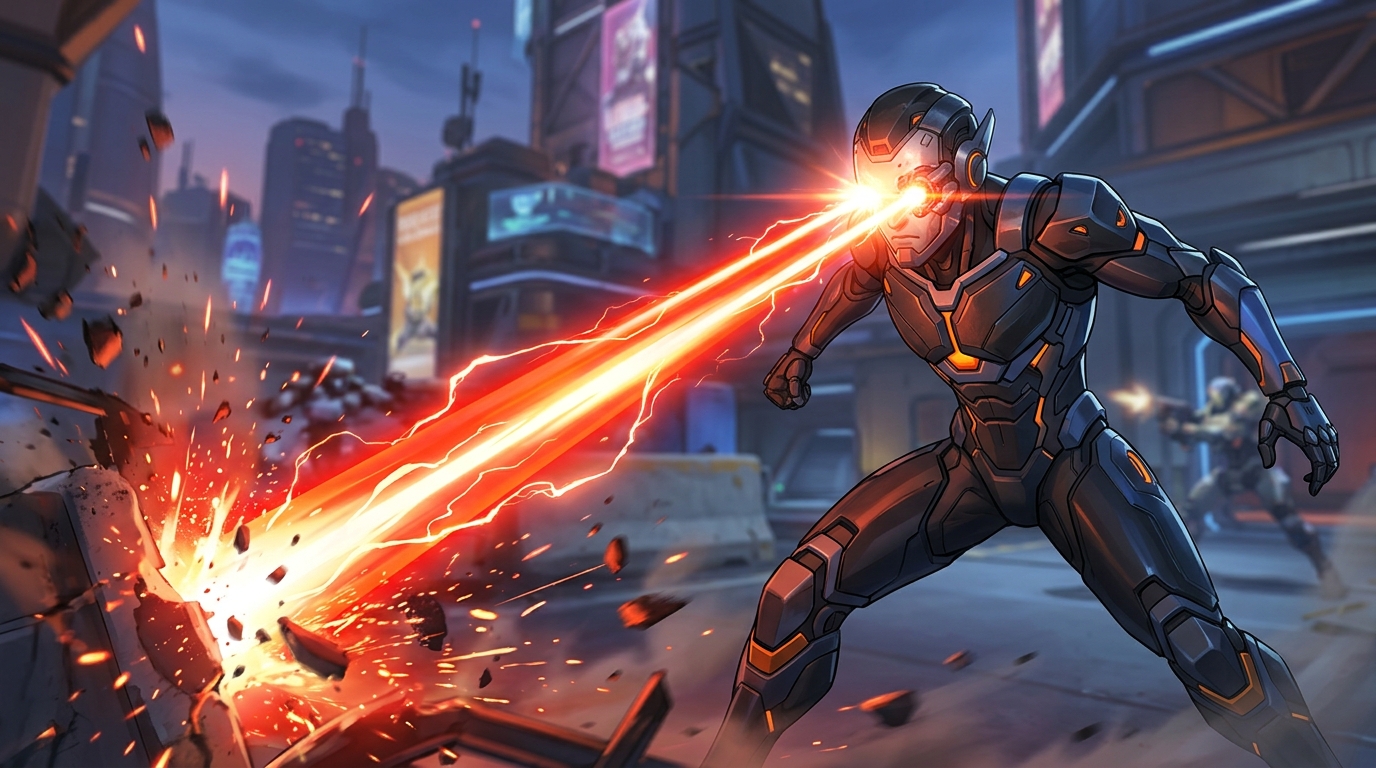
Placeholder mechanics frequently fade into development obscurity, but unique visual archetypes rarely disappear forever inside Blizzard’s design department. When pressed on whether ocular beams could ever officially make their way into a public hero roster, Associate Game Director Alec Dawson acknowledged the inherent fun of the mechanic.
The concept of weaponized ocular hardware has a long, revered history across comic books and sci-fi pop culture, from Marvel’s Cyclops to classic sci-fi cyborgs. In a universe that already features genetically modified lunar gorillas, cybernetic ninjas, roller-skating freedom fighters, and jetpack-assisted combat concepts, a hero weaponizing facial cybernetics or visor-focused particle beams sits comfortably within established aesthetic boundaries.
Implementing such a character requires overcoming specific technical and balance hurdles:
-
First-Person Viewport Clutter: A beam emanating directly from the ocular plane can obscure the player’s target view unless designed with clean transparency shaders.
-
Third-Person Line-of-Sight Readability: Opponents must clearly identify when and where an ocular beam is charging, necessitating distinct head-tracking animations and telegraphed pupil glows.
-
Role Classification: An ocular weapon naturally lends itself to sustained tracking (Damage archetype) or precise defensive piercing (Tank deterrence), demanding an ability kit that rewards rigid directional aim without inducing motion sickness.
If Blizzard commits to the archetype, Dawson noted that the creative foundation remains wide open, giving designers free rein to translate a humorous early-engine bug into a polished competitive tool.
Evolution of Laser Mechanics in Modern Hero Design
While Tracer relinquished her optical weaponry, energy beams found diverse expressions across the Overwatch cast over the subsequent decade. Blizzard gradually perfected how directed energy interacts with shields, armor, and kinetic barriers.
Each iteration refined the initial visual-line experiments conducted in 2013:
Zarya’s Linear Particle Beam
Unlike the static red prototype lines, Zarya’s Particle Cannon introduced dynamic thickness and audio pitching tied directly to her barrier absorption charge. It established how the engine handles unbroken straight-line collision against layered target geometries.
Symmetra’s Ramping Photon Projector
Symmetra’s primary fire shifted from an auto-locking tether into a thick, direct hitscan beam that charges tiers upon dealing sustained damage. This design directly mirrors the tracking discipline required by the original camera-bound developer tests.
Echo’s Execution Protocol
Echo’s Focusing Beam applies immense damage modifiers to targets resting below fifty percent health. This mechanic proved that short-duration, high-intensity forward beams could create dramatic competitive inflection points without breaking character agility.
These evolutions demonstrate that directed-energy weaponry represents some of the most reliable, interactive mechanics in the engine. Adapting that technology to an ocular firing anchor requires adjusting the visual origin point from weapon viewmodel coordinates to character socket models.
The Creative Legacy of Engine Placeholders
The game development industry is filled with world-class mechanics that began as hasty placeholders or humorous engineering bugs. The history of character combat reveals that unpolished early builds serve as an essential playground for structural innovation:
-
Grand Theft Auto‘s hyper-aggressive police AI originated from an erratic pathfinding bug in an early top-down build named Race’n’Chase.
-
Street Fighter II‘s entire combo structure was born from a glitch allowing players to cancel basic strike recovery frames into special moves.
-
Team Fortress‘s iconic Spy class materialized because an initial Quake mod glitch rendered a player’s model with the enemy team’s uniform color.
Tracer’s ocular laser experiment sits in this exact category. In constructing a hero meant to anchor an entirely new intellectual property, developers prioritized functionality over aesthetic fidelity. The willingness to run around digital test chambers firing debug lines from character eyes laid the direct foundation for the silky hit-registration, smooth spatial awareness, and responsive shooting that made Overwatch a global phenomenon.
Whether or not Blizzard officially debuts an operative sporting weaponized cybernetic pupils, the red-eyed prototype remains a masterclass example of rapid development methodology: build the tool, test the feel, embrace the absurdity, and polish the mechanics until greatness emerges.
Frequently Asked Questions
Did Tracer actually have eye lasers in any public version of Overwatch?
No. The eye-laser mechanic was strictly an internal engine placeholder used during late 2013 closed tests. It was never included in closed betas, open technical tests, or any commercial release of the game.
Why did Blizzard make Tracer fire lasers from her eyes during development?
In late 2013, Blizzard had built the foundation of the Overwatch engine but had not yet developed first-person weapon models, projectile physics, or firing animations. To quickly test player hit detection and movement, programmers tied two red raycast lines directly to the player camera’s forward vector.
Will a future Overwatch hero shoot lasers out of their eyes?
While Blizzard has not announced a specific hero with this ability, Associate Game Director Alec Dawson confirmed that the studio views ocular laser weapons as a compelling concept, noting that the team could explore it for future character rosters.
How did developers replace Tracer’s early eye beams?
Once the base engine proved stable, Blizzard replaced the debug eye vectors with Tracer’s signature pulse pistols. This change introduced high-spread hitscan bullets, realistic reload animations, and balanced her kit around close-quarters flanking maneuvers rather than static directional beams.