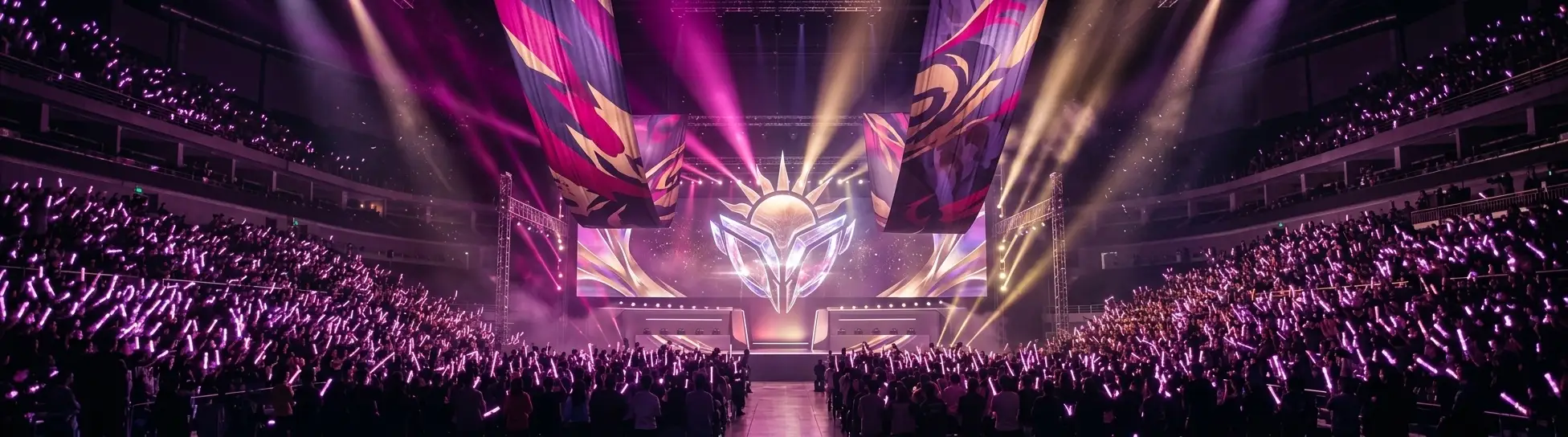

Six months ago, in Seoul, a Brazilian woman named Natália “daiki” Vilela leaned forward into a microphone holding a Finals MVP bracelet, eyes wet, watching her teammates lift the first international VALORANT Game Changers Championship trophy ever brought home to South America. The map was Split. The deciding scoreline was 13-8. The room sounded like a stadium had eaten itself. It was, by any reasonable measure, the loudest, brightest, most emotionally satisfying moment in the five-year history of competitive women’s esports.
Two days later, Esports Charts published the viewership numbers. The same tournament had recorded the lowest peak audience in Game Changers history. A 40.8% drop in Hours Watched year-over-year. A 51% drop in peak from 2024’s championship.
Welcome to women in esports in 2026. The trophies are real. The crowds are smaller. The funding is shakier than it’s been since the program started. And somehow, despite all of it, the scene is, against the odds, still building. We’re going to walk through exactly what’s happening, why it’s the year that decides what comes next, and what your role in it can actually be.
TL;DR for the people on the way to a scrim: As of May 2026, women’s esports is hitting a pivotal moment. VALORANT Game Changers crowned its first Brazilian champion in November 2025 (Team Liquid Brazil over Shopify Rebellion Gold, 3-2), but the championship’s peak viewership of 228,672 was the lowest in series history. ESL Impact, the largest women’s Counter-Strike circuit, was suspended in late 2025 due to an “unsustainable economic model.” FC Barcelona launched its first all-female esports team in January 2026. The IOC suspended its Esports Commission on May 3, 2026. The next 12 months will determine whether women’s esports becomes a permanent pillar or shrinks back into a grassroots movement.
The numbers, without the spin
Most articles about women in esports either go full pep rally or full obituary. Neither is right in 2026. Here’s the actual landscape, sourced and timestamped.
The good:
- Team Liquid Brazil won the VCT Game Changers Championship 2025 in Seoul, defeating two-time champions Shopify Rebellion Gold 3-2. First Brazilian championship in Game Changers history. Natália “daiki” Vilela took Finals MVP.
- The prize pool was $500,000, with Team Liquid taking home $180,000.
- FC Barcelona, one of the most globally recognized sports brands in the world, unveiled its first all-female esports team on January 14, 2026. Captain María “Toki” Pérez became the first Spanish player to qualify for a Game Changers Championship.
- KATSEYE, the global girl group, performed the official VALORANT 2025 Game Changers Championship anthem.
- New women-focused circuits launched to fill gaps: JB Pro League Female ($25,000 prize pool), Rainhas do Clutch ($30,000 prize pool in Brazil), BC.Game Masters women’s circuit, ELITE FE, Female Pro League.
- VALORANT has approximately 12 million weekly players, and the women’s community within it is one of the most engaged demographics in the entire shooter space.
The hard:
- VALORANT Game Changers Championship 2025 peak viewership: 228,672 concurrent viewers. That’s a 51% drop from 2024’s championship peak of around 450,000.
- ESL Impact, the largest and most prestigious women’s Counter-Strike league, was suspended in October 2025 after EFG cited an “unsustainable economic model.”
- Several major CS organizations followed the suspension by closing or reducing their women’s divisions, including NIP Impact, Imperial Valkyries, and BIG EQUIPA.
- The IOC officially suspended its Esports Commission on May 3, 2026, scrapping the 2027 Olympic Esports Games and the 12-year Saudi partnership behind it.
- A “girls-only” VALORANT tournament organized by femaleplayersTN in May 2026 generated backlash for excluding trans women and using AI-generated promotional graphics.
- According to Esports News UK reporting, Game Changers itself faces concerns about its long-term sustainability as an isolated side ecosystem rather than a true pathway to top-tier VCT competition.
Both columns are true at the same time. That’s the assignment we are all reading from now.
What ESL Impact going dark actually means
This is the single most under-discussed story of the year in women’s esports, and it matters more than most of the news that gets bigger headlines.
For context, the ESL Impact League was, from 2022 through late 2025, the only consistent, high-prize, internationally-broadcast competitive women’s Counter-Strike circuit. At its peak, the Impact League Finals offered a $123,000 prize pool and a full LAN production. The circuit gave us champions like Imperial Valkyries (who won six straight Impact titles), FURIA Fe, NAVI Javelins, and BIG EQUIPA (the final champion in Season 8). It featured the first sustained pathway for women in CS at the professional level since the Electronic Sports World Cup days of the mid-2000s.
In October 2025, ESL FACEIT Group (owned by Saudi Arabia’s PIF-backed Savvy Games Group, for those keeping score) announced the program was suspended. The cited reason was that the “current economic model is simply not sustainable.” Translation: the math didn’t work.
The aftermath, per Hotspawn’s May 2026 deep dive: NIP and Imperial Valkyries dropped their women’s divisions almost immediately. BIG EQUIPA held on until earlier this year before stepping back. Imperial CEO Felippe “felippe” Martins committed to keeping the Valkyries roster active, “from a business perspective” trying to “reinvent” how value gets generated outside the server.
In the void, third-party tournament organizers stepped up. JB Pro League Female 2026 Season 1 ran in February with a $25,000 prize pool. Rainhas do Clutch 2026 is going to LAN in Rio de Janeiro this year with around $30,000 in prize money. The Athena League has zero prize pool but still draws competitive teams. The grassroots is alive, just visibly underfunded next to the corporate machine that just left.
The pattern is the pattern: when the biggest organizer leaves, the scene doesn’t die. It fractures into smaller, more passionate, less well-funded pieces. Whether that ends up being a feature or a bug depends entirely on what the next twelve months bring.
Game Changers’ identity crisis, by the numbers
If ESL Impact is the cautionary tale, Game Changers is the live experiment. And the experiment is, depending on which corner of the VALORANT community you ask, either succeeding or quietly stalling out.
The case for “succeeding”:
- Four different champions in four years (G2 Gozen 2022, Team Liquid Brazil 2023, Shopify Rebellion Gold 2024, Team Liquid Brazil 2025). Real competitive depth.
- Massive global production. The 2025 Championship at LoL PARK in Seoul drew sponsors including Omen by HP, HyperX, Red Bull, Secretlab, Verizon, MasterCard, Crunchyroll, AWS, and Coinbase. The event’s media value clocked in at $1,882,814 per Esports Charts.
- Genuine cross-genre cultural moments. KATSEYE performing the anthem is the kind of mainstream pop crossover that no other women’s-focused esports event has pulled off.
- 80+ qualifier events around the world feeding into 10 regional teams.
The case for “stalling”:
- The viewership math is, again, brutal. GCC 2025 averaged just 71,183 viewers across its 53 hours of airtime. That’s well below where Game Changers needs to be to justify the long-term sponsor commitment.
- According to recent reporting, several organizations have either exited or quietly scaled back their Game Changers investments since 2024.
- The structural question, raised in multiple industry think pieces over the last six weeks: is Game Changers actually a pathway to the main VCT, or has it become an isolated parallel league that drains audience attention away from a hypothetical mixed-gender future?
Riot’s official position, going back to Senior Director Whalen Rozelle’s 2021 launch interviews, has always been that the goal is for the program to eventually become unnecessary. “I hope we don’t see gender anymore when we are looking at the professional players,” EMEA Game Changers lead Vera Wienken said in 2022. “We might not even need Game Changers anymore in the future because it’s just so normal that esports is diverse.”
That’s the dream. The 2026 reality is that the bridge between Game Changers and the main VCT is still narrow, and the foot traffic on it is mostly going one direction.
The trans inclusion fight is the hardest conversation in the scene
This is the part nobody wants to write about. Let’s do it anyway, because pretending it isn’t happening doesn’t help anyone.
On May 1, 2026, a tournament organizer called femaleplayersTN ran a “girls-only” VALORANT event and was caught two ways at once. Their promotional graphic was AI-generated, which generated immediate community pushback. And, more importantly, when asked publicly whether trans women were eligible to compete, the org’s response was effectively no.
The pushback was loud and largely came from inside the women’s esports community itself. VALORANT on-air talent Billie “billieidk” Purdie framed it simply in coverage at Esports Insider: “Be clear in how you communicate with your community so they know what to expect, but most importantly, be open to feedback, instead of shutting those voices down.”
Most of the major Game Changers leagues, including Riot’s official VCT Game Changers program, operate on a “marginalized genders” framework that explicitly includes trans women, non-binary players, and gender-nonconforming individuals. The femaleplayersTN ruleset broke from that consensus, and the scene’s response was to close ranks around the broader inclusion model.
There is no neutral position on this conversation. The point of writing about it for an audience that includes tournament organizers, not just spectators, is to be honest about where the community standard sits in 2026. The standard, across the largest and most-watched circuits, is “marginalized genders,” not “cisgender women only.” Pretending otherwise is, increasingly, a way to put yourself outside the mainstream of women’s esports rather than inside it.
Tournament organizers who want to run inclusive events have a body of public best-practice documentation to learn from, including Game Changers’ own ruleset, the AnyKey toolkit (anykey.org), and ESL’s #GGFORALL initiative documentation.
The Olympic ghost
If you missed it: on May 3, 2026, IOC President Kirsty Coventry officially suspended the IOC Esports Commission, effectively ending the dream of an Olympic Esports Games in the near term. The 12-year Saudi partnership signed in 2024 had already been mutually terminated in October 2025. The 2027 Riyadh event is gone. The Pause and Reflect period that Coventry announced earlier this year is now indefinite.
Why does this matter for women in esports specifically?
Because Olympic inclusion was supposed to be a back door into traditional sports-style legitimacy and funding. Olympic disciplines get gender-balanced participation rules by default. Olympic federations get state-level investment. Olympic athletes get government-backed development pathways. None of that exists in current esports at scale, and a successful Olympic Esports Games would have started to import some of that infrastructure into the gaming world.
That’s gone for at least the rest of the decade. What’s filling the gap is, predictably, more privately-funded events. The Esports Nations Cup in Saudi Arabia, launching November 2026. The Global Esports Federation’s continued expansion. Regional federations like FERJEE (Rio de Janeiro) building country-specific women’s circuits like Clutch Queens, the international version of Rainhas do Clutch.
The result is that women’s esports in 2026 is, more than ever, dependent on private capital and grassroots organizing. Not federation-style oversight. That cuts both ways. It’s faster and more responsive. It’s also more fragile when the money gets nervous.
The grassroots is, quietly, the real story

Here’s where it gets interesting for anyone reading this who actually runs tournaments, plays in them, or organizes for them, which is most of you on Tournova.
The big league corporate funding cycle is one story. The grassroots, semi-pro, university, regional, and platform-hosted layer is a completely different one, and it’s currently growing faster than any other part of the women’s esports ecosystem.
A non-exhaustive sample of what’s happening on the ground right now:
University and academic circuits: AnyKey’s research arm has tracked over 175 collegiate esports programs in North America alone with active women’s and inclusion-focused initiatives as of late 2025. Programs at universities including UC Irvine, University of Akron, Maryville, and Boise State are running their own women’s invitationals.
Regional federations: FERJEE in Rio is running Clutch Queens. Spain’s FEXE (Federación Española de Videojuegos y Esports) has been actively integrating women’s brackets into national qualifiers since 2024.
Community-led leagues: Female Pro League ran its inaugural LAN finals in Kazakhstan last year. The Athena League is operating with zero prize pool but real competitive teams. FECS (Female Counter-Strike), hosted on FACEIT, is described in scene coverage as “the biggest female community” with monthly tournaments and qualifiers.
Game-specific initiatives: Apex Legends, Rocket League, Mortal Kombat, Tekken, Street Fighter, and Splatoon all have community-organized women’s tournaments running in 2026. Smaller prize pools, smaller production. Real player development.
Platform layer: Tournament hosting platforms (yes, including Tournova) are increasingly building features specifically to support inclusive ruleset templates, ELO matchmaking for mixed-skill brackets, and community moderation tools that help organizers maintain safe spaces.
The pattern is consistent across all these. Women’s esports isn’t dying. It’s decentralizing. The corporate top of the pyramid is wobbling. The bottom of the pyramid is wider than it’s ever been.
What 2026 is actually deciding
Predictions are bad. Frameworks are useful.
Here are the three things 2026 will functionally answer, and what each outcome means.
Question 1: Does Riot keep investing in Game Changers at current levels?
If yes, the program survives at scale and the bridge to the main VCT gets stronger. If no, Game Changers becomes one of several mid-sized women’s leagues rather than the global standard.
The early signal will be the 2026 Game Changers Championship later this year, and whether viewership recovers above the 2025 floor. If it doesn’t, expect organizational quiet conversations to start by Q1 2027.
Question 2: Can a new women’s CS circuit replace ESL Impact?
If yes, women’s Counter-Strike stabilizes around a smaller but viable budget level. If no, the top women’s CS players migrate either to mixed Tier 2 teams (like FlyQuest RED’s BiBiAhn, who’s been competitive against male opposition in NA in 2026) or out of the scene entirely.
The early signal will be whether JB Pro League Female and Rainhas do Clutch can grow their prize pools and attendance over multiple seasons.
Question 3: Does the next big sponsor wave commit to women’s esports or pull back?
If FC Barcelona’s January 2026 launch represents a trend (legacy traditional sports brands entering women’s competitive gaming for brand reasons), the funding picture brightens. If FC Barcelona stays an outlier, the picture stays dark.
The early signal will be the next two major roster announcements from non-endemic legacy brands. If we see another major football, basketball, or motorsport organization launch a women’s gaming team in 2026, that’s a real trend forming.
All three answers will land in the next twelve months. Save this article and check back. Or don’t, the internet’s been weird about archive culture lately.
What this means for you (if you run, play, or watch tournaments)
Tournova hosts thousands of tournaments. This section is for the people on either side of those brackets.
If you organize tournaments:
- Default to a clear, written ruleset that uses “marginalized genders” language rather than “women only.” It signals professional intent and aligns with how the major circuits operate.
- Publish your code of conduct before sign-ups open. Make harassment-reporting visible and not buried.
- Partner with existing community hubs (FECS for CS, AnyKey for cross-game, regional federations for territory-specific events). Don’t reinvent. Plug in.
- Pay your talent. Even small prize pools matter for player development. Free-to-enter tournaments are great. Zero-prize tournaments make the players carry the value entirely.
If you play:
- Find your community before you find your bracket. FECS, the various Game Changers Discords, university esports clubs, and women-focused Discord servers for each game are all alive and active in 2026.
- Mixed-team and women-only brackets aren’t competing goals. Both are needed. Both are valid skill-development paths.
- Document your matches. The single most replicable thing in modern competitive gaming is the highlight clip on social. Your career growth is partially a clip portfolio.
If you watch and want to support:
- The most effective thing you can do is show up to streams. Game Changers, JB Pro League, Rainhas do Clutch, university broadcasts. Viewership numbers are the single biggest input to the sustainability conversation, full stop.
- Buy team merch from women’s-roster orgs. Small revenue line items add up over a season.
- Talk about specific players, not “women in esports” as an abstract category. Daiki, Toki, vicu, ASTRA, sarah, meL, BiBiAhn. Names move careers.
The bottom line
In 2018 if you had asked any industry analyst whether women’s esports would survive the next eight years, the question would have read as charity. As of May 13, 2026, the question has changed shape entirely. The question now is whether the scene survives the next eight months in its current form. And the answer, looking at FC Barcelona’s January launch, at daiki holding the GCC trophy, at the dozens of grassroots circuits filling in for ESL Impact, at the FECS Discord still going strong, is yes. Probably yes.
Not on the easy version. Not on the well-funded version. Not on the corporate-PR-handout version. But yes.
The scene is being rebuilt right now, in real time, by tournament organizers running brackets with $500 prize pools, by 20-year-old players sleeping on couches in Bucharest for bootcamps, by Spanish football clubs adding gaming jerseys, by Brazilian federations refusing to let the lights go out, by Discord moderators staying online at 2 a.m. to keep harassment out of their servers.
If you’ve read this far, you already care. Pick one thing this week. Watch a stream you wouldn’t have watched. Drop a few dollars on a women’s team’s merch shop. Run a tournament with a clear inclusion ruleset. Show up.
That’s how movements that are big enough to be worth fighting over actually get built.
- WP. See you in the brackets.
FAQ: Women in esports in 2026
Who won the VCT Game Changers Championship 2025?
Team Liquid Brazil won the VALORANT Game Changers Championship 2025 in Seoul, South Korea, defeating Shopify Rebellion Gold 3-2 in the grand final on November 30, 2025. Natália “daiki” Vilela was named Finals MVP. The win made Team Liquid Brazil the first Brazilian team to win a Game Changers Championship event.
Why was ESL Impact suspended?
ESL FACEIT Group suspended ESL Impact, the largest women’s Counter-Strike 2 circuit, in October 2025, citing an “unsustainable economic model.” The decision affected the entire women’s CS2 professional ecosystem and triggered a wave of organizations including NIP, Imperial Valkyries, and BIG EQUIPA either closing or scaling back their women’s divisions.
What replaced ESL Impact in 2026?
Multiple smaller circuits have emerged to fill the gap, including JB Pro League Female ($25,000 prize pool), Rainhas do Clutch in Brazil (~$30,000 prize pool), BC.Game Masters online events, ELITE FE (backed by Vitality and Skin.Club), and the Athena League. None individually match ESL Impact’s scale or prize pool, but together they keep the competitive scene active.
Is FC Barcelona really in Game Changers?
Yes. FC Barcelona announced its first all-female esports team on January 14, 2026. The roster includes captain María “Toki” Pérez, Alba “Annie” García, Paula “Devilasa” Blanco, Eylül “miyori” Sarıoğlu, and İlayda “Lyda” Güzeldere, with coach Fabián “Quick” Pereira. The team competes in VALORANT Game Changers EMEA.
Did the IOC really cancel Olympic esports?
Yes. The IOC officially suspended its Esports Commission on May 3, 2026, under new President Kirsty Coventry. This followed the October 30, 2025 mutual cancellation of the 12-year Olympic Esports Games partnership with Saudi Arabia. The planned 2027 Olympic Esports Games will not take place. The IOC has indicated it will pursue a “new approach” to esports but has not committed to a timeline.
Are trans women allowed in VALORANT Game Changers?
Yes. VALORANT Game Changers and the major women’s esports circuits use a “marginalized genders” framework that explicitly includes trans women, non-binary, and gender-nonconforming players. A May 2026 tournament organized by femaleplayersTN that excluded trans women generated significant community backlash and was widely treated as outside the mainstream standard of women’s esports.
What is the prize pool for women’s esports events in 2026?
Prize pools vary significantly by event. VCT Game Changers Championship 2025 had a $500,000 prize pool. JB Pro League Female 2026 Season 1 had $25,000. Rainhas do Clutch 2026 has approximately $30,000. Most regional Game Changers events have prize pools in the $50,000 to $200,000 range. Community and grassroots events typically range from $0 to $5,000.
Why is women’s esports viewership declining?
Game Changers Championship 2025 saw a 51% drop in peak viewers and 40.8% drop in hours watched compared to 2024. Factors cited in industry reporting include sponsor fatigue, the absence of breakthrough storylines reaching mainstream audiences, increased competition from mixed-gender events, the lack of a clear pathway from Game Changers to top-tier VCT, and broader esports viewership softening across multiple titles in late 2025.
How can I support women in esports?
Watch the official broadcasts to drive viewership numbers, follow individual players on social media to amplify their visibility, buy merchandise from women’s-roster organizations, support tournament platforms running inclusive events, attend local LAN events when possible, and if you run tournaments, adopt “marginalized genders” inclusion rulesets aligned with Game Changers and the AnyKey toolkit.
Who are the top women players in esports right now?
By 2025-2026 performance, standout names include Natália “daiki” Vilela (Team Liquid Brazil, VALORANT – GCC 2025 Finals MVP), Melanie “meL” Capone (Shopify Rebellion Gold, VALORANT), Mayline-Joy “ASTRA” Champliaud (BIG EQUIPA → Pigeons, CS2 – HLTV Women’s Player of the Year 2025), Wiktoria “vicu” Janicka (Pigeons, CS2 AWPer), Alexandra “twenty3” Timonina (Pigeons, CS2), and Bruna “bizinha” Marvila (FURIA fe, CS2).