

Every amateur esports team is born the same way.
Five friends are on voice chat at 2 a.m., they just clutched a ranked game they had no business winning, and someone says the sentence: “Bro, we should go pro.”
Six months later, the Discord is a graveyard. One guy stopped showing up to scrims. Another one quit because “the vibe changed.” The IGL is now silently coaching a different team. The org name – the one you spent four hours designing a logo for – is a dead Instagram account with three posts and zero followers who aren’t your cousins.
This does not happen because you weren’t good enough. It happens because nobody ever wrote down what the team actually was.
So let’s do that now. Here is the realistic, unromantic, evergreen playbook for building an esports team that survives long enough to matter.
Step 1: Decide What Kind of Team You’re Actually Building
Before roles, before tryouts, before the logo, answer one question honestly.
Is this a competitive team or a content team?
A competitive team exists to win. Practice is not optional. Losing hurts. You measure yourselves against ladders and tournaments. You may earn nothing for a long time.
A content team exists to be watched. Winning is nice but not the point. Personalities matter more than mechanics. The measurement is views, clips, community.
A hybrid can work – most modern orgs are hybrids – but only if everyone knows which side takes priority when the two collide. When the streamer wants to play a fun off-meta comp the night before a qualifier, someone has to already know the answer.
If you skip this question, every decision after it becomes an argument.
Step 2: Pick a Game You’ll Still Care About in a Year
Amateur teams love to chase whatever is hot. Then the meta shifts, the player count drops, and half your roster wants to switch titles.
Choose a game where you can answer yes to all four:
- There is a real, published competitive ecosystem (open qualifiers, ranked ladders, publisher-supported paths).
- The player base is stable or growing.
- Your roster genuinely enjoys grinding it, not just watching it.
- You can actually schedule matches in your timezone.
The last one kills more teams than skill gaps. If your five players are spread across three continents, you are not building a team, you are building a nightmare Google Calendar.
Step 3: Build the Roles Before You Build the Roster
Do not start with names. Start with slots.
For a five-person tactical shooter squad, you typically need:
- IGL (In-Game Leader): calls strats, adapts mid-round, owns the macro.
- Entry / Duelist: takes first contact, opens sites, dies first on purpose.
- Anchor / Sentinel: holds sites, plays for information, dies last on purpose.
- Flex / Support: utility, trades, plugs whatever gap the comp needs.
- AWPer / Sniper (game-dependent): the win-condition player, gets the tools and the space.
For a MOBA, replace with lanes and jungle. For a fighting game team, replace with mains and counter-picks.
The point is the same: write the job description before you interview.
Now, when someone new joins, they know exactly what they are being asked to do. And when tension shows up, and it will, you can point at the role, not the person.
Step 4: Actually Run Tryouts (Not Vibe Checks)
“Vibe check” tryouts are how bad teams get built. You add a person because they’re funny in voice chat, and three weeks later you realize they’ve never once un-muted during a scrim.
A real tryout has three layers:
- Mechanical layer. Two ranked games or a custom aim/practice server. Are the fundamentals there for the role you need?
- Team layer. Two scrims with your actual squad. Not against your squad — with them. Can they hear a callout and act on it inside two seconds?
- Human layer. One 20-minute conversation, off the game. What do they want from this team? What are their non-negotiables? What happens when they tilt?
That third one is the one everyone skips. It is also the one that would have saved 80% of the teams that fell apart.
Step 5: Structure Practice Like Adults, Not Like Addicts
The classic amateur team practice schedule is: nothing, nothing, nothing, then eleven hours the day before the tournament.
That is not practice. That is panic with a Discord invite.
A sustainable weekly rhythm looks more like this:
- 2–3 scrims per week, 2–3 hours each, with a set start and end time.
- 1 VOD review, 45–60 minutes, focused on one specific thing (not “everything we did wrong”).
- 1 theory session, 30 minutes, where the IGL walks the team through new setups or map ideas.
- Individual ranked, self-directed, tracked loosely.
- 1 full off-day, minimum. Non-negotiable. Brains need it, wrists need it, relationships need it.
Fewer, sharper sessions beat endless grind sessions. Every professional coach in every established title will tell you the same thing.
Step 6: Give Someone the Boring Job
Every team that survives has one person who does the un-fun work.
They:
- Register the team for tournaments.
- Read the rulebook (yes, all of it).
- Track scrim results.
- Chase substitutes when someone can’t show.
- Post reminders 15 minutes before match time.
- Handle disputes with organizers.
- Keep the roster document updated.
This person is often not the best player. They are the reason the best players can just play.
Sometimes it’s a manager. Sometimes it’s the IGL. Sometimes it’s a rotating role. It cannot be nobody. “Nobody” is who runs 90% of failed rosters.
Step 7: Money Comes Last — But Talk About It First
Most amateur teams will not earn meaningful money for a long time. That is fine. What is not fine is pretending the question doesn’t exist.
Before any prize money, sponsor kit, or streaming deal shows up, agree in writing:
- How is prize money split? Equal shares? Player + manager cut? Org share?
- Who owns the team name and logo?
- What happens to shared assets if a player leaves?
- Who signs sponsor deals – and what percentage do individual players get?
- What is the exit process if someone gets picked up by a bigger org?
This conversation is awkward for exactly one afternoon. Skipping it is awkward forever.
Step 8: Compete Early, Compete Small, Compete Often
Do not wait until you are “ready.” You are not ready. Nobody is ever ready.
Enter small community tournaments — the $50 Discord cups, the weekly online cash cups, the platform-run open ladders. Losing a first round to a random team is worth more than another month of scrims against yourselves. You will learn:
- How your team performs under actual tournament pressure.
- Whether your IGL can call in a real Bo3.
- Which players tilt and how fast.
- Whether your practice is translating to real matches.
Then you go back, watch the VOD, and fix one thing. Not five. One.
Do this for a year and you will be shocked at how far ahead of your peer group you are, because most of them will not have made it a year.
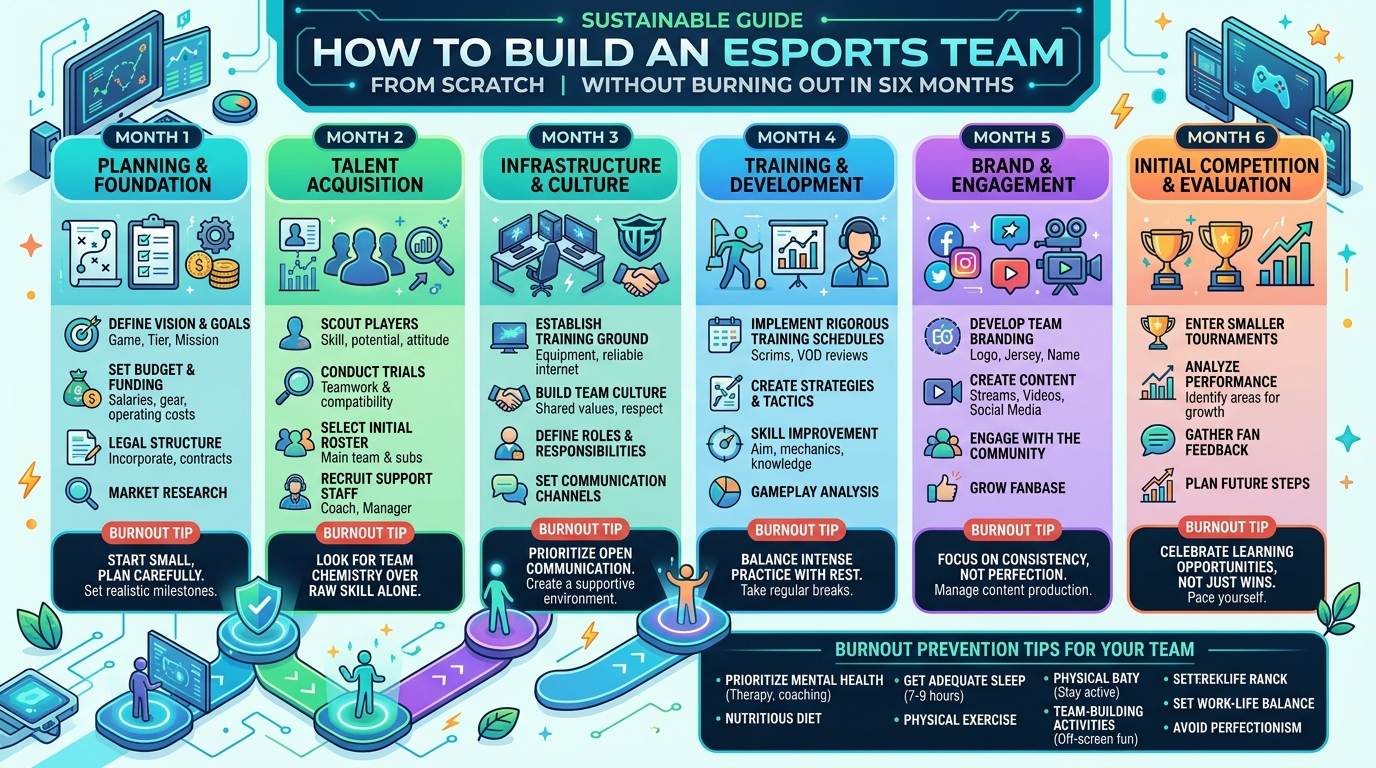
The Realistic Timeline
If you are honest and consistent, here is roughly what growth looks like:
- Months 1–2: Finalize roles, roster, and schedule. Play community cups. Lose most of them.
- Months 3–4: Start winning small brackets. Build a highlight reel. First social media traction.
- Months 5–8: Consistent top-8 in community cups. First small sponsor conversations. First roster change (this is normal).
- Months 9–12: Qualifier attempts for larger circuits. First real prize money. First interview requests.
- Year 2: You are now the amateur team other amateur teams are scared of.
Notice what is not on this list: overnight fame, a six-figure contract, or a signing announcement with a smoke-machine video.
Those things happen. They almost never happen fast.
The One Thing That Actually Matters
Talent is not rare. What is rare is a team that still shows up in month seven; after the losses, after someone rage-quit, after the meta shifted, after real life got in the way.
Build the boring stuff, the roles, the schedule, the agreements, the boring-job person, and you buy yourself the one advantage nobody else has:
Time.
Everyone else will fold. You will still be playing.
That is how esports teams actually get built.
FAQ
How many players do I need to start an esports team?
It depends on the game. Tactical shooters like Counter-Strike 2 and VALORANT need 5 starters and ideally 1–2 substitutes. MOBAs like League of Legends and Dota 2 need 5 starters. Fighting games and racing titles can operate with 2–4 players. Always plan for at least one substitute per role.
How much does it cost to start an amateur esports team?
An amateur online esports team can start for close to $0 if players already own the game and hardware. Realistic recurring costs include tournament entry fees, a Discord Nitro or server boost, coaching or analyst tools, and any team branding. Serious teams usually spend $50–$300 per month across the roster in the first year.
Do amateur esports teams need contracts?
Yes. Even without paid salaries, teams should have a written agreement covering prize money splits, team name and asset ownership, sponsor deal terms, and the process for a player leaving. This prevents the disputes that end most amateur rosters.
How often should an esports team practice?
Most sustainable amateur teams run 2–3 scrims per week, one dedicated VOD review, one theory session, and at least one full off-day. Consistent shorter sessions produce better long-term results than occasional 10-hour marathons.
How do amateur esports teams make money?
Early revenue usually comes from small tournament prize pools, community platform payouts, streaming (subs, tips, ads), affiliate links, small brand deals, and eventually an organization signing. Sustainable income typically arrives in year two, not month two.